
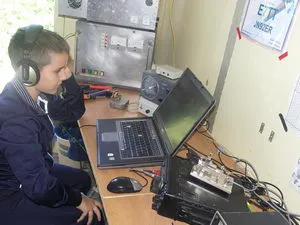
Another UKT contest weekend has come and gone. Taught by years of experience, we did not expect much in terms of a possible result, but a secret hope still existed, otherwise it would all have made no sense! Because of problems getting up to Leotar, since work was under way on laying fiber-optic cable along the road toward the summit of Leotar, we began raising the antenna system already on Thursday, so that on Friday evening we raised the system to operating height and mounted the rest of the equipment. Everything was done in a kind of hurry and in the pauses when it was possible to get through the dug-up road to the summit of Leotar.
After everything had been set up and ready, testing the equipment indicated a high level of noise on receive when anode voltage appears on the linear, but the reason is unknown to us, because earlier in the same system everything had worked normally. Since it was already night, we left the problem to plague us overnight and to try to solve it on Saturday, because we had enough time.
On Saturday we nevertheless arrived at Leotar a little earlier than planned, because we were not clear about where the noise on receive was coming from, what the problem was, and whether we would have to go back with the equipment to the Club workshop. We suspected the linear's HV rectifier, because it had caused problems in the previous 6m competition. However, it soon turned out that it was not the rectifier, but we still did not know where the problem came from. Tests showed that the antenna system worked normally on transmit, on receive the LNA function could be felt, but it was as if there were no antenna system behind the LNA, and the noise disappeared when the linear's output circuit was detuned. Very strange! With additional tests we located the fault at the antenna mast; suspicion fell on a faulty coax relay, and at around 15:00, just an hour before the start of the contest, we lowered the mast to check the LNA and the coax relay. We immediately noticed the problem in the swapped positions of the rx coax and the antenna on the coax relay. That is how it goes when there is a lot of talking while working, and the contest has not even started yet! We corrected the error, tested the system, everything was OK. We raised the mast to operating height again. 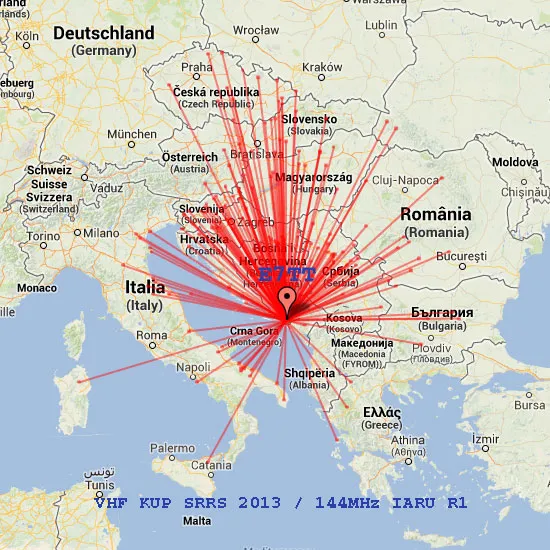 The good fortune is that the mast is telescopic, so raising it with a little muscle was finished in a few minutes.
The start of the contest went quite solidly. In the first hour the score was 32 QSOs, which for our circumstances is quite satisfactory. Propagation promised that it could be interesting. As we moved into the night the score became solid and well above the multi-year average. That secretly gave us hope that we might finally pass what is for us the magic figure of 200 QSOs. At midnight we went in with a score of 130 QSOs. However, the new day did not pass as we had imagined and expected. With the help of the KST chat we arranged several good contacts, but from 05:00 to 07:00, when it becomes very interesting on KST, we had to stop operating. E73RO had to go to work, and Deki E73NO was to come as a replacement. We went down to Trebinje and straight back. On returning around 07:00 we continued operating, but there were fewer and fewer signals that we heard that we had not already worked. With a lot of calling we somehow managed by 14:00 to push the score to 186 contacts and 82k points. In the last hour a new problem troubled us, RF breakthrough into the modulation.
Perhaps in the remaining 2 hours of the contest a few more contacts could have been logged, but because of the RF problem and other obligations we finished operating at 14:30.
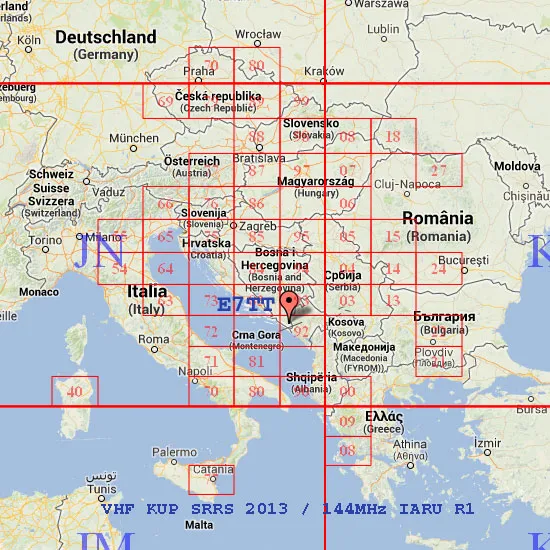
After everything done in this contest and years of experience, all that remains is for us to draw the general conclusion that we have exhausted our possibilities of making any more serious improvement in the results achieved from this location with the existing equipment. It turned out that this time we only worked the participants we could hear a little faster than usual. The average contact of 437km indicates that we are falling short in contacts of 200-400km, and the already known problem with increased noise when we turn toward azimuth 280-320°, which is caused by the diffuse antenna tower about 50 meters from our micro-location, also significantly reduces our score with Italian stations from the north, which also bring a significant number of points.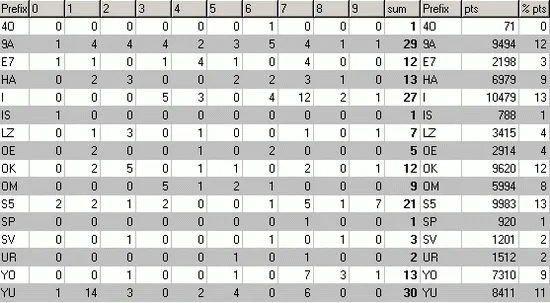
Here briefly is the rest of the statistics:
186 QSO, 81289 points, 53 locators, 437km/QSO, 927km ODX (OL4W/JN70LR)
Finally, let us mention one positive thing about this contest, and that is the debut in the UKT contest of the young operator Deki, E73NO, for whom this was a new experience, which he successfully mastered, and in a few hours of operating he improved the overall score by about ten contacts with an excellent QRB.
And let us also say that the E7TT team in this contest consisted of the operators: Mladen E73RO, Deki E73NO, Daki E73XL and Zoran E73S.
73, until we hear each other in one of the coming contests!
Information: Zoran, E73S