
True, there are not many such teams, but several teams fight for the European trophy, taking turns on the throne from year to year (DR9A, OE1W…)
So, since R1 is large, the winner is largely dictated by micro-location too, and of course one should not forget technical equipment and operators, so we can freely add the factor of conditions and weather. To make it interesting for everyone and to let everyone find a goal of their own, many national associations — including ours — organize a contest at the same time, under the same rules, for the whole of R1. They call their contests by various names; ours is the UKT KUP SRRS.
The E74EBL academic radio club took part in this contest again this year. Although long-range weather forecasts announced bad weather for operating from remote locations — or, as we say, from portable — we decided to go out to one of the peaks. The original idea of operating from Klekovača fell through, and the choice fell, so to speak, on our own backyard — Ponir. We hoped the forecasts would miss a little in our favor and that there would be no rain or thunder during the contest days. Not only did they miss in our favor, it was even worse than forecast.
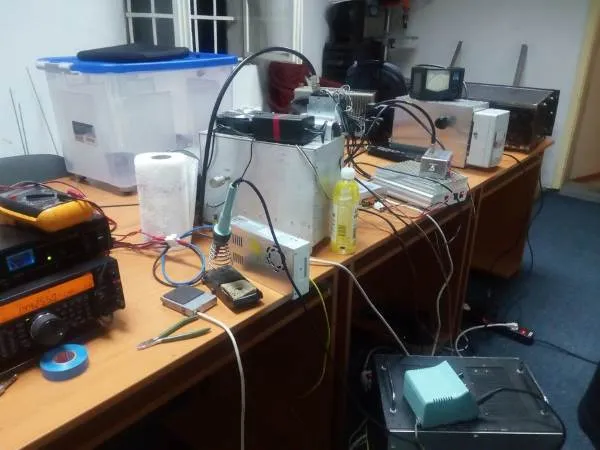 Once the decision was made, the equipment for portable operation had to be prepared. Collecting and testing the equipment took almost seven days. The club does not have all the necessary equipment, so we pooled equipment with members. We met daily and progressed slowly toward the final setup. Radios, amplifiers, antennas, cables, accessory boxes, relays, masts — everything that might be needed, and certainly some things that would not — we prepared to carry to the location.
Ponir was the first choice for such weather forecasts full of rain and thunderstorms. So we needed a solid building, mains power, and access over a rainy and wet road, high enough to operate from, and not too far away… As several times before, we chose this hill, which at over 600 m above sea level offers everything listed above. At the very top of the western slopes of Ponir, with a beautiful view of Banja Luka, is the TV Simić facility, and our kind host, Mr. Vlado Simić, offered us hospitality and his help in realizing this rather demanding project.
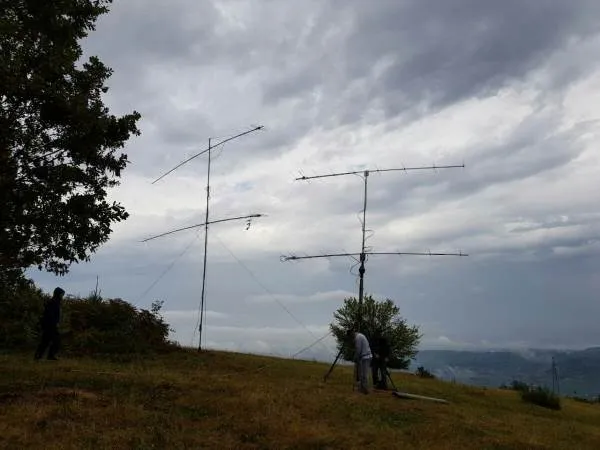
Departure to the location was planned for Friday, when in the morning part of the team managed to deliver and unload most of the equipment. The rest of the team arrived in the late afternoon, and assembling four antenna systems lasted until late in the evening. The 2x15 and 2x10 element systems were raised without major problems. Both of these systems had rotators. The systems of two times 4x6 elements were fixed, one facing west and the other east. There is no need to mention that we set this up in the rain, which fell the whole time, sometimes harder, sometimes lighter.
Since we planned two radio stations connected to a transverter, the idea was for each of the two operators to have one fixed and one rotary antenna system on receive, while transmission would go to all antenna systems regardless of which radio was used. Such a concept requires a sufficient number of operators, and this kind of receive distribution system greatly speeds up operation. There were also local skimmers that were supposed to fill the band map and spare us from listening through the telegraphy part of the band. It was done as conceived.
 Part of the team returned to Banja Luka on Friday evening. The return to Ponir was agreed for early morning, so that we would have enough time to finish setting up the equipment.
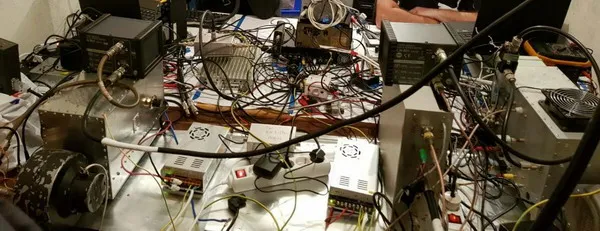
Everything looked fine; the mosaic was being assembled slowly, cable by cable, relay by relay, coax by coax. A pile of equipment on the table. We still had a few hours before the start of the contest and everything looked as it should. Final testing just before the contest brought the first problems.
Wet weather affected the increased level of reflection on the antennas, and this in turn contributed to increased RF leakage around the shack. Similar problems had occurred before at almost all outdoor locations, and additional grounding, inserting various toroids, winding cables and coax into bundles, and invoking magic usually helped. This time there was no magic; RF simply got into the microphone of the Heil headset. Using the original hand microphone helps, but it also reduces operating comfort. Never mind, at least we got rid of the RF problem. Perhaps more time should be devoted to the combination of the Microham and the Heil headset, so that in the future we avoid this problem or reduce it to a minimum.
Just before the start of the contest, only a few minutes before the start, the rain intensified, the receiver filled with crackling, and only nearby and strongest stations could be heard on the band. The very beginning was slow and exhausting, with numerous repeats of the exchange, so we went out a few times to see whether the antennas were on the masts at all. They were. A sloppy start, and the rest was no better — a struggle for every contact. Because of heavy precipitation and moisture we lost one 4x6 element system, while the other showed critically high SWR, so we had to reduce power significantly.
Thunder… With every lightning strike we had interference that made reception of already weak signals even harder… Somewhere after midnight the rain seemed to stop a little, so that hour or two brought several fast and distant contacts. Our hopes for an improvement in the weather were in vain, because shortly afterward it began to rain again. It was clear from the very beginning that there would be nothing from a good result, and we expected that with this equipment, given a little luck with conditions, we could reach 200K. Vain wishes and hopes. Toward the end, more or less with the help of the KST chat, we made a few contacts and passed a meager 300 contacts. An average of over 420 km per contact brought us a result of almost 130K points. A brief analysis says that our farthest contact was with DF0AA, at a distant 839 km, that we worked over 60 Czechs, only 26 Italians, and very few — 19 stations from Germany. We worked a fair number of Bulgarians, and one Greek and one Swiss. Those are not the farthest contacts, but they are rare in our logs. Besides the Czechs, the most numerous in the log are Slovenians, Croats, and Serbs. From the north we worked 13 Poles, a fair number of Slovaks, the standard few Hungarians, and the expected number of Romanians and a couple of Ukrainians. Let us not forget quite a few stations from BiH. We heard distant stations from over 900 km, but could not call them.
The somewhat brighter part of the contest weekend was the socializing organized upstairs or under a tent in the yard. There, neither rain nor bad weather bothered us. Perhaps the traditional kotlić was missing this time, but the grill was in play.
Just as we began assembly in the rain, so we dismantled system by system, folded the antennas, packed the equipment, and before dark reached the club, where we unloaded everything. Yes, in the rain, wet, of course.
 There were much higher expectations for this contest — in terms of results, I mean — but what can you do; it was more or less similar for everyone, and you remember the DR9A team from the beginning of the story: that team made over 1100 contacts and more than 500K points… In the entire history of the contest, only a few teams have managed to pass half a million points. Bad weather bypassed them, or they had such weather a day or two before the contest. To be clear, even if things had not been as they were, our expectations were far, far below their result. Hats off to the German team, and not only to them…
In the days after the contest we checked the equipment and cables, and so found several problematic spots. Bad connections on cables, water in the antenna feed boxes, and all of that probably contributed to the mentioned RF problems…
This contest showed us that vulnerable parts of the equipment in wet operating conditions, and especially the connections and joints of coaxial sections, need to be well secured. The experience from this contest will be used on another occasion in some new contest, but we would like it without rain, if at all possible.
Going out and planning, as well as operating in this contest, would not have been possible without the help of the CZ Department, which once again provided us with a field vehicle, and without the kind Mr. Simić, who provided us with the facility and all the comfort that goes with it. Thank you.
In the E7DX team's operation this time, besides members of our club, radio amateurs from RK Nikola Tesla also took part, sharing with us all the troubles and the pleasure of operating in this contest.
If I may add a few words about the amount of equipment used these days in VHF contests. I look at what we carried up to Ponir — five people unloading for an hour... So much equipment stirs a twofold feeling in me. A feeling of satisfaction that, more or less, we keep pace with modern trends and equipment in VHF and contesting in general. Modern transverters, sophisticated radios, computers, skimmers... Without at least a few — not antennas, but systems — one does not even think of going out. There are various auxiliary devices, filters, various “low loss” modern coax cables, propagation simulations, chats, clusters, weather radars, computer analyses....
The other feeling is longing for the former, past times when one yagi — most often a home-made copy of some well-known brand, or a design someone photocopied from Radio-amater magazine or some world magazine — was enough.
A radio, if there was an amplifier, an antenna, a key, a microphone, hand-turning of various masts, a Honda E300 or some larger generator — that was mostly all that was carried to a hilltop, most often on foot. Unfortunately, those times are gone...
I have gone out a few times, for several hours, to one of the hilltops with classic tourist equipment, just to satisfy the urge. An antenna, a radio, a battery, and the feeling was the same as more than 40 years ago.
A few photos convey the conditions at the location during the contest, both outside and inside. Our host made a suitable video story that is broadcast on the TV Simić cable channel, and it will soon be available on YouTube as well.
Info: Vlado, E70T
Final adjustment and testing of equipment at the club.
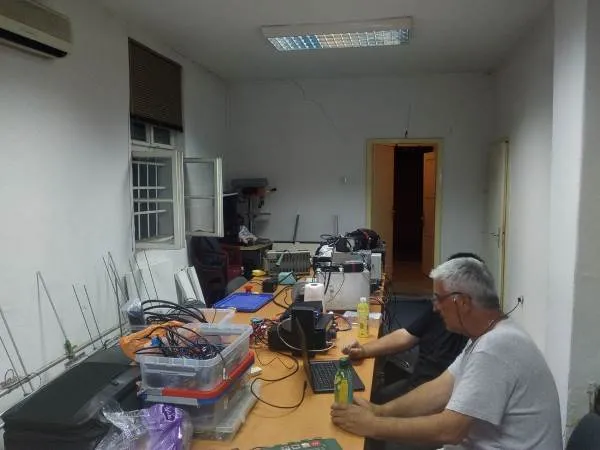
Ranko E70R and Zoran E76C testing the equipment
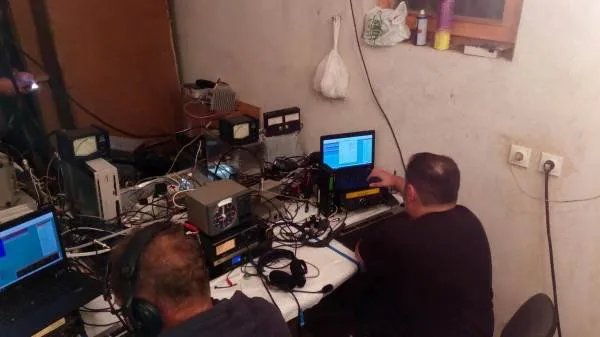
Rade E77W and Zoran E76C in the shack
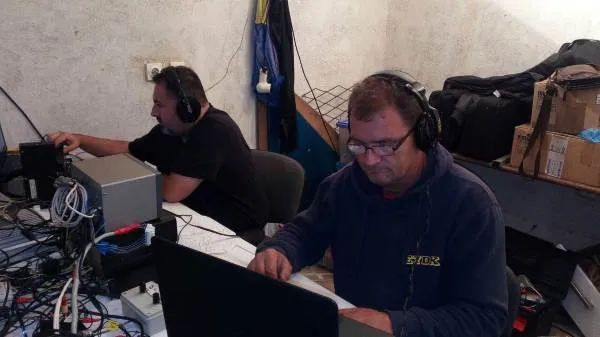
Again, Rade E77W and Zoran E76C from another perspective
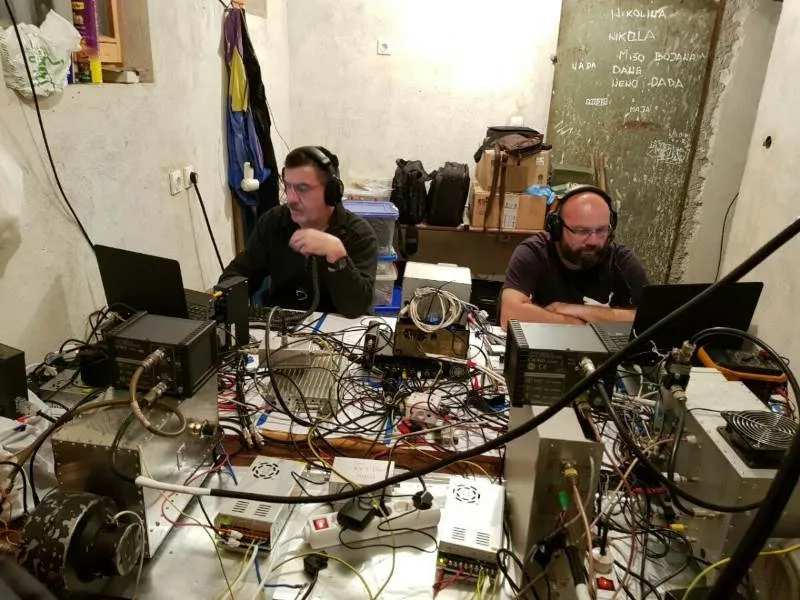
Vlado E70T and Robi E77E in the shack
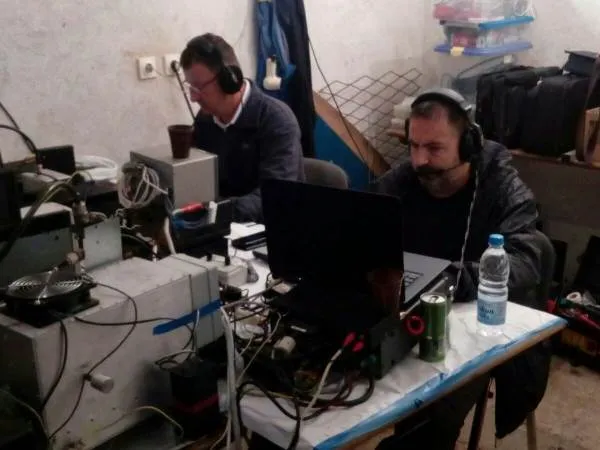
Stevo E73CV and Zoran E76C in the shack
Antenna systems 2x15 el. and 2x10 el.
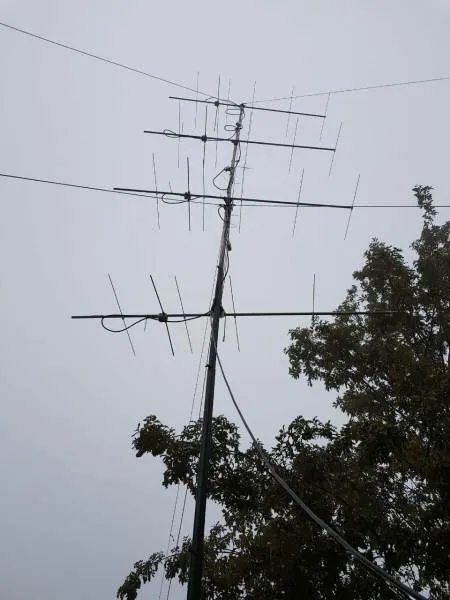
Antenna system 4x6 el.
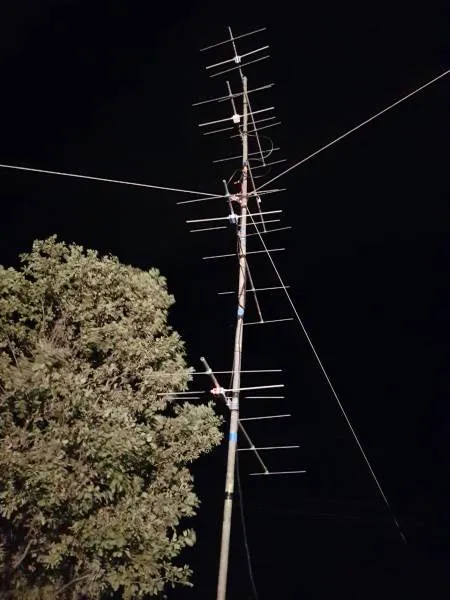
Antenna system 4x6 el.
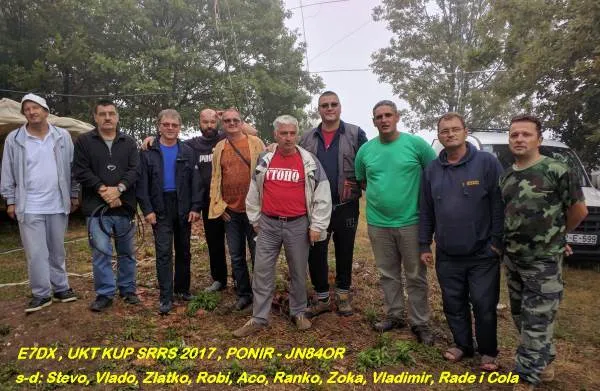
And finally the E7DX team