
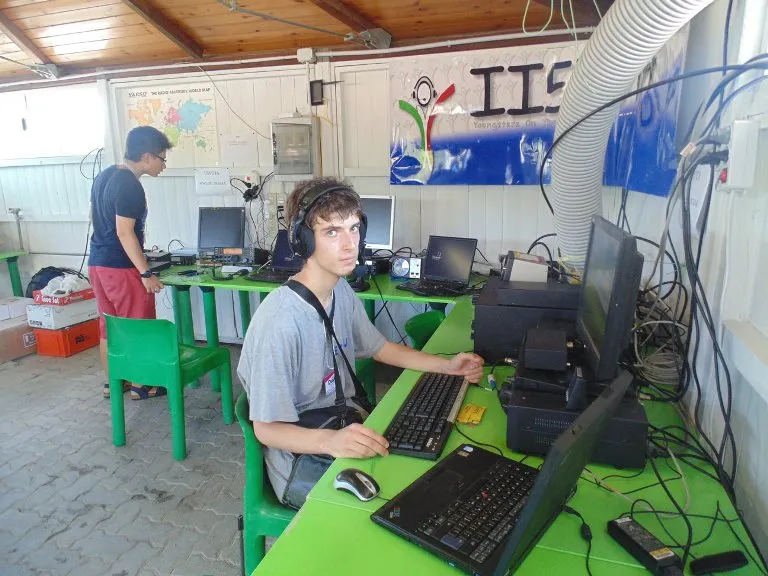
From 18 to 25 July, the 5th gathering of young amateur radio operators of IARU Region 1, YOTA 2015, was held in the small Italian town of Marina di Massa in Tuscany, and yours truly had the honor and pleasure of attending such an event. But before I describe in more detail what happened at the camp, I think it would be appropriate to say something about the YOTA program itself.
YOTA (Youngsters on the Air) is a movement whose goal is to encourage as many young people as possible, primarily school-age children, to join our hobby, which unfortunately grows older year after year. Operators who spend a lot of time on the shortwave bands remember that in December there is a large number of stations with the YOTA suffix. December has been officially proclaimed the month of the YOTA program, and that is when YOTA coordinators set out to actively promote amateur radio, visiting schools, giving lectures to young people and in that way trying to encourage them to join us. Of course, there is also work on special stations, but the emphasis is not on making as many contacts as possible; the point of those stations is to use their activity to help as many young people as possible take their first steps on the air. At the camp there was talk of involving E7, i.e. some of the organizers expressed a wish that a YOTA station from Republika Srpska also be on the air in December. I hope that project goes as well as possible.
As had been planned earlier, I was supposed to travel accompanied by two YLs, Anđela E79AS and Jovanka E74YL, in the role of team "leader". Unfortunately, the two of them canceled the trip due to family obligations. That disrupted my plans for the camp, so I had to improvise somewhat. In any case, I left Banja Luka on Friday, 17 July at 16:00. After a three-hour drive, I arrived in Zagreb. I used the next few hours for a short tour of the city, since the bus for Florence was leaving at 2 a.m. The bus arrived after some 40 minutes of delay, and at last we set off for Italy. After about 10 hours of bumping along - QTH Florence. At the station I was met by Simone IW5EDI, who owns the DX-Zone website. A short lunch with him, and I boarded the train to Pisa, which was the meeting point for the camp participants. Another delay. Because of a fire, the train stood for 50 minutes, but in the end I arrived at the railway station in Pisa where the organizers were waiting. In a very short time we reached Marina di Massa. Administrative formalities, room assignment, and after that free time. I used the first day to try my hand at SSB pile-up operating in several languages, and it went quite well. Saturday passed in getting to know the other participants, and it was also worth cooling off a bit because the temperature was almost 40 degrees Celsius.
FOTOGALERIJA YOTA 2015
{gallery}yota2015{/gallery}
Sunday was the most interesting day for me. At around 15:00, the exam for the American amateur radio license was held. The examination committee consisted of 3 volunteer examiners, Mauro I1JQJ/N1JQJ, Vinicio IK2CIO/N7CIO and Rinaldo IZ1MGH/K4AS. I took the exam and passed first the Technician, then the General class. Extra class remains for some other time. As for the callsign, it has not been issued yet, but when I get it I think I will change it for some "vanity callsign". Before that, Silvano I2YSB and his team of expeditioners gave us a presentation about their activities, in this particular case the 9Q0HQ and 5Z0L expeditions. The evening was reserved for an intercultural meeting. The purpose of this is for each participant to present their country and culture in a few minutes. Participants usually bring food and drink from their countries, and of course promotional material, such as tourist offerings and the like. My teammates were supposed to bring some food and drink with them, but since they canceled, I was left short of that. At least I distributed to the participants promotional material about the tourist opportunities of Republika Srpska. I would like to take this opportunity to thank the Tourist Organization of Republika Srpska, which donated some brochures and prospectuses to us. That evening went off in the best order. Laughter and song echoed late into the night. There were many moments to remember.
The working week began with the Good Morning activity. The leader of the Polish team, Jurek SP3SLU, through the roughly 20 minutes it lasted, tried to bring the skill of telegraphy closer to the camp participants (there were very few CW operators). During the week, I had the pleasure of helping him with his presentations, which helped me to make a more notable showing. After that, other activities began, and the first on the schedule was a presentation on amateur radio direction finding, given by the Bulgarian team led by Panayot LZ1US, who has been involved in ARDF for 50 years. I must note that it was extremely interesting, especially for me, since it was my first contact with that kind of activity. Certainly an interesting activity that deserves attention. After ARDF, Florian OE3FTA gave the participants a short presentation on SSB operating, both in contests and pile-ups and in everyday DX work. Of Monday's activities, one should also mention the visit by the company Messi&Paoloni, a manufacturer of high-quality coaxial cables. Mr. Stefano Mesi, one of the co-owners, gave us a lecture covering everything from the principles of coaxial cable and how it is manufactured to its practical use. On the technical side, a little more complicated than it should be.
Monday was also reserved for the VHF/UHF handheld competition, which was in no way different from classic field day competitions. The 2m and 70cm bands were used. In not such easy competition, I won in the "all bands" category under the callsign K1N. An interesting activity, no doubt about it.
Tuesday, like the previous days. After breakfast, there followed fifteen minutes of "wake-up games", which we played on Sunday and Monday and on the following days as well. Usually these were lively and dynamic games intended to shake off even the last bit of sleepiness among the participants. After that, Good Morning, then presentations. On Tuesday we listened to a presentation about amateur radio on the International Space Station - ARISS. But since YOTA is not just talking and talking, we also took up soldering irons and tried to build a small 20m receiver for PSK31, based on the British team's project. Everyone succeeded at that. Tuesday evening, a very interesting activity on the schedule - a treasure hunt. The Dutch team placed 15 balloons around the camp grounds with short questions related to amateur radio, and the correct answers gave the location of the "treasure".
Wednesday was reserved for a bit of real tourism, a trip to Florence, the cradle of the Renaissance and one of the most beautiful Italian cities, and to Pisa and the famous Leaning Tower. We visited many interesting locations and had the opportunity to admire great works of art, such as the cathedral in Florence, for example.
Thursday was also a very dynamic day. Colleagues from Spain taught us something about the capabilities of SDR, and as an example showed us an SDR recording of the VHF/UHF competition. After them, again a bit of talk about software, this time by the Belgian team, then a short presentation on the principle of operation of the Yagi antenna, which the Italian hosts gave us. In addition, we became acquainted with the YCP - Youth contest program, which is supported by IARU and consists of young radio amateurs taking part as a team in a contest from one of the well-known contest locations. In the afternoon, an off-air contest. A simulation of a contest at 3 benches, representing 20, 40 and 80m. Very exciting. Thursday evening, a lottery. I forgot to mention earlier that Piero Begali I2RTF, a well-known key manufacturer, visited us. He donated 2 keys, a Begali Simplex as a prize in the lottery, and a second key, the Begali Signature, to be the official key of the YOTA program. The first key went to a participant from Estonia, and the second key is intended as a trophy, i.e. it stays for a year with one of the more distinguished camp participants. I am glad that I was granted the honor of being the owner of the Begali key until the next YOTA meeting.
Friday, a meeting of team leaders at which the question of licensing radio amateurs in different countries, the question of involving young people in amateur radio and similar matters were discussed. Another of the more interesting activities was the visit by the D4C contest team. Fabio I4UFH introduced us to the Monteverde contest location and its potential. After that, the YOTA open day, where the organizers handed out modest gifts to us, and where each participant had the opportunity to express their impressions. In the evening, a farewell party on the beach, which lasted into the small hours. Of course, the PPS was also active non-stop, for those who wanted to make a few more contacts.
Saturday morning, saying goodbye to friends and gradually dispersing. I left the camp around 9 o'clock and headed for Pisa, boarded the train to Florence and at 12:15, took the bus to Zagreb. I arrived in Banja Luka at around 5 in the morning the next day.
I forgot to mention that I used some time and, from the PPS set up by the Poles, briefly operated as I5/E77CW. I managed to make contacts with E7TESLA and E73RB from our stations, and with II5YOTA, I made a 20m CW contact with E77O and E74BYZ.
In the end, what can I say but that this was one of the best experiences ever for me. Spending 7 days with fellow radio amateurs from 21 countries, meeting new faces, new cultures, forming friendships that open the way to new horizons, is priceless.
I would like to take this opportunity to express my deep gratitude to the Public Fund for Child Protection of Republika Srpska, without whose donation this trip would not have been possible, and of course to the Radio Amateur Association of Republika Srpska.
73!
Duško, E77CW